DAILY LOGIC PUZZLE SUITE • FREE WEB EDITION

NYTSudoku

The gold standard of daily number puzzles. Pure deductive clarity, single unique solutions, and an ad-free solving environment designed to elevate your cognitive flow.

DAILY DOSSIERNo. 2,842 • Nov 27, 2026
100% Unique SolutionsAlgorithmic purity • Zero guessing required
48,200+ Solvers TodayWorldwide morning cognitive ritual
Smart Solving ToolkitPencil notes, auto-candidate marks & live checks
Mistakes:Err:0/3
7
3
2
9
4
3
4
2
6
5
4
7
9
1
8
2
5
9
8
9
9
2
3
1
5
1
6
2

Daily Challenge

Complete today's puzzle!

‹Nov 27, 2026›
Play Today →

Why Play NYT Sudoku?

Boost Your Brain

Improve memory and logic

Track Progress

See your best scores

Multiple Levels

Easy to Hard

Daily Challenges

Never stop challenging yourself

A calm daily ritual for puzzle solvers who enjoy clean, honest logic.

Play Today's Puzzle →
CHOOSE YOUR CHALLENGE LEVEL

Play Free NYT Sudoku Now!

Jump into today's free NYT Sudoku puzzle or practice on any difficulty level. Every grid has a single verified solution, saves your progress automatically, and gives you unlimited daily plays without a paywall.

Free Unlimited Puzzles
Auto-Saves to Browser
Zero Forced Video Ads
Smart Hints and Notes

NYT Sudoku Difficulty Benchmark and Average Solve Times

Direct comparison of starting clue counts, average solve durations, and primary deduction methods across all official puzzle levels.

Difficulty LevelStarting CluesAverage Solve TimeCore Solving TechniqueRecommended Solver Context
Easy Sudoku36 to 40 clues3 to 7 minutesCross-hatching, Last free cellMorning wake-up with coffee
Medium Sudoku30 to 35 clues9 to 16 minutesHidden singles, Candidate notesBalanced daily lunch break challenge
Hard Sudoku26 to 29 clues18 to 35 minutesNaked pairs, Pointing pairs, Box-line reductionFocused evening deduction session
Expert Sudoku22 to 25 clues35 to 55 minutesX-Wings, XY-Wings, Candidate chainsExperienced logic veterans
Master Sudoku17 to 21 clues50+ minutesSwordfish, Simple coloring, Medusa chainsMinimalist clue masters
Killer SudokuArithmetic cages15 to 30 minutesRule of 45, Cage combinationsSolvers who enjoy mental math
BY PLAYERS, FOR PLAYERS

About NYT Sudoku

We built this site because we love daily newspaper word games and numerical puzzles, and wanted a clean place to solve without distractions.

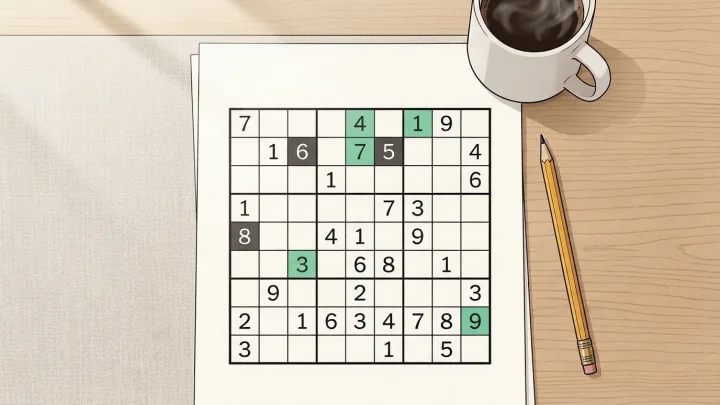
New York Times style daily Sudoku puzzle solver desk with morning coffee, pencil, and 9x9 logic grid
Our Daily Solver Philosophy

Why We Built a Cleaner Sudoku Experience

If you do the New York Times Games lineup every day, whether you start with Wordle and Connections or go straight to the daily Crossword and Sudoku, you know how good a well-designed puzzle feels. But finding a clean place to play online without thirty-second video ads, bloated popups, or sloppy grids with multiple valid solutions can be surprisingly hard.

We built this site as daily players ourselves. Every grid has a single verified solution, your timer and candidate notes save right in your browser, and you can play as many games as you want on desktop, tablet, or phone without a subscription.

Guaranteed Single Solutions

Every puzzle is checked by a backtracking solver to make sure there is exactly one valid answer. You never have to guess.

Clean Editorial Grid

Crisp typography, high-contrast dark green lines, and subtle cell highlights that keep your eyes comfortable during long solves.

Fast Candidate Notes

Toggle pencil marks with the N key. Solved numbers automatically clear obsolete notes from connected rows, columns, and boxes.

Full Privacy and No Paywall

No paywalls, accounts, or personal data collection. Your game times, streaks, and settings stay private in your browser LocalStorage.

STEP-BY-STEP SOLVER GUIDE

How to play NYT Sudoku

Sudoku is purely about spatial deduction and process of elimination. Here are four practical habits that help you solve any 9x9 board with confidence.

The three core rules of Sudoku: filling numbers 1 to 9 in every row, column, and 3x3 block without repeating
01

The Three Core Rules

The 9x9 board holds 81 cells divided into nine 3x3 boxes. Every horizontal row, vertical column, and 3x3 block must hold numbers 1 through 9 exactly once without repeating any digit.

Scanning a Sudoku board with cross-hatching to find the single available cell for a number
02

Scan with Cross-Hatching

Pick a digit that already appears four or five times across the board. Trace its rows and columns into neighboring 3x3 boxes. Those lines block out empty cells, often leaving only one legal spot for that number.

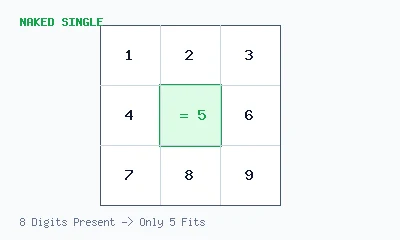
Identifying a naked single cell where intersecting rows and columns eliminate all other digits
03

Find Naked Singles

Check cells that sit near crowded rows and boxes. If the intersecting row, column, and 3x3 block already contain eight different numbers, the remaining digit has to go in that cell.

Writing small candidate pencil notes inside open cells to track possible numbers
04

Pencil in Candidate Notes

On Medium and Hard puzzles, obvious single numbers run out quickly. Tap N or click Notes to write down the two or three numbers that could legally fit in each open cell. This makes hidden pairs easy to spot.

PRACTICAL SOLVER TIPS

NYT Sudoku Tips

Practical tips and deduction habits from everyday solvers to help you shave minutes off your timer and work through stubborn boards.

WHAT TO DO WHEN STUCKTIP 01

When a Hint Is Not Helpful, Look for Pairs

On many puzzle apps, clicking Hint simply flashes a random cell without explaining why a number goes there. If you feel stuck on a Medium or Hard puzzle, step back and look for cells with only two pencil candidates. Finding two identical pairs in the same row or column eliminates those numbers from the rest of that line.

BENCHMARK TIMESTIP 02

Average Solving Times to Aim For

Experienced solvers generally finish Easy in 3 to 7 minutes, while beginners take 8 to 12 minutes. Medium typically takes 9 to 16 minutes once candidate notes become necessary. On Hard, solving times range from 18 to 35 minutes. Don't worry about speed right away; steady logic naturally makes you faster.

KEYPAD COUNTERSTIP 03

Track Unplaced Numbers on the Keypad

The small counter under each digit on the keypad shows how many copies of that number still need to be placed. When a digit reaches zero, it dims out with a checkmark. Clearing numbers with only one or two copies left makes the rest of the board much easier to read.

ADVANCED NOTATIONTIP 04

Box-Line Reductions for Hard Puzzles

When all possible positions for a candidate inside a 3x3 block align along a single row or column, that candidate cannot appear anywhere else in that line. That simple deduction clears out crowded rows on Hard and Expert boards without guessing.

SOLVER KNOWLEDGE BASE

Frequently Asked Questions

Real answers from daily players about reset schedules, blue numbers, red dots, hints, and average solve times.

When does NYT Sudoku reset each day?

The daily New York Times puzzle updates at 10:00 PM Eastern Time (7:00 PM Pacific) on weekday evenings, and at 6:00 PM Eastern Time on weekends. This schedule lets East Coast players tackle tomorrow's puzzle before bed while West Coast players can solve it with dinner. On our site, you can play anytime without waiting for the evening reset, and you can explore our Daily Challenges archive whenever you want to revisit past boards.

Why does NYT Sudoku reset so early in the evening?

The early evening release matches the print edition publishing schedule of the newspaper. Digital puzzles drop as soon as the print edition files are transmitted to the printing press, which happens between 6:00 PM and 10:00 PM Eastern. This synchronized release gives print subscribers and digital solvers access to the next day's challenge at roughly the same time.

Does NYT Sudoku get harder during the week?

Many solvers wonder if Sudoku scales in difficulty through the week like the NYT Crossword, which gets progressively tougher from Monday to Saturday. Sudoku does not follow that pattern. The difficulty does not change based on the day of the week. Instead, every single day offers three distinct levels (Easy, Medium, and Hard). A Monday Hard grid requires the exact same logical techniques as a Thursday or Saturday Hard grid.

What do the blue numbers mean in NYT Sudoku?

Blue numbers are the original starting clues provided by the puzzle at the start of the game. They are locked into the grid and cannot be changed or cleared. Any digits you place yourself appear in standard slate or white text, helping you immediately tell your own deduction entries apart from the initial board setup.

What does the red dot mean on a cell in NYT Sudoku?

A small red dot in the corner of a cell indicates an immediate rule conflict. When auto-check or conflict detection is enabled, the game flags any cell that shares the same number with another cell in the same row, column, or 3x3 block. If you see a red dot appear, double-check that region to catch the duplicate digit before continuing.

How do hints work in NYT Sudoku, and what does a hint mean?

Tapping Hint prompts the algorithm to look for the single cell with the most direct logical elimination and fill in the correct number. Sometimes a hint feels unhelpful because the system enters a number in a corner cell without explaining the underlying reasoning. When that happens, look at the neighboring blocks for pointing pairs or candidate pairs that forced the placement, or switch to pencil notes to reveal the chain of deduction yourself.

How do you use center-mark notation and candidate notes in NYT Sudoku?

Pressing N on your keyboard or tapping the Notes button activates pencil-marking mode. Instead of entering a large final number, selecting digits will place smaller candidate numbers in the center of the cell. This center-mark notation is essential for tracking potential digits, spotting naked pairs, and eliminating impossible candidates as you work through harder boards.

What is a good time for NYT Hard Sudoku, and how do you solve it?

A solid solving time for NYT Hard usually sits between 15 and 25 minutes for regular players without using hints. Experienced speed solvers can often finish in under 12 minutes, while relaxed weekend solvers frequently take 30 to 45 minutes over coffee. Solving Hard puzzles requires looking beyond basic cross-hatching. You will need to spot naked pairs, hidden pairs, pointing pairs, and box-line reductions to crack the grid.

Have more questions about NYT Sudoku?

Explore our comprehensive solver guide covering medium solve times, beginner techniques, daily archives back to 2020, and puzzle comparisons.

Browse All Questions & Answers

Keyboard Controls & Shortcuts

1 - 9Enter Digit
N / SpaceToggle Notes
Del / BackspaceErase
Arrow KeysMove Cell
Ctrl+ZUndo Move
HSmart Hint
P / EscPause
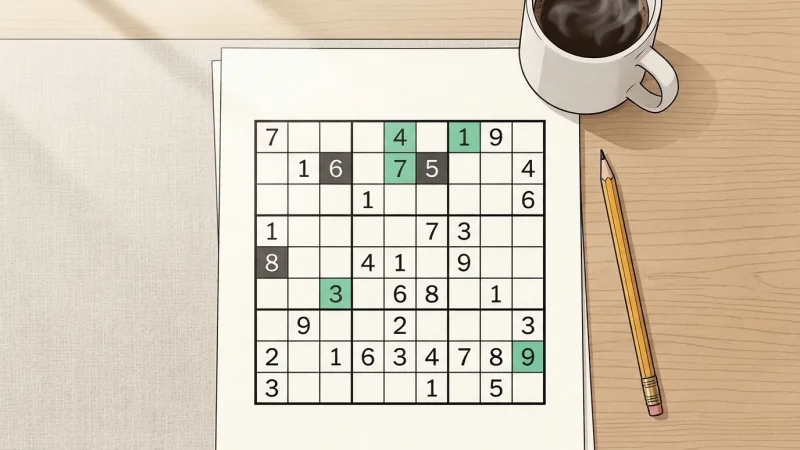
The daily Sudoku solving ritual: focused mental logic puzzle on a wooden desk with morning coffee and notebook

Solving Hard Sudoku

Play free NYT Hard Sudoku online. Demanding deductive logic with under 30 starting clues, naked pairs, and box-line reduction. Free forever.

Helpful Habits for Hard Puzzles

  • Look for naked pairs. When two cells in the same line or box contain the exact same two candidates, eliminate those two digits from all other cells in that zone.
  • Use pointing pairs. If a candidate within a 3x3 box aligns along a single row, it cannot appear anywhere else in that row.
  • Apply box-line reduction to trim candidates before placing numbers.

Daily Player Features

We designed this site with the features we always wanted as daily solvers:

  • Single unique solutions verified by backtracking solvers with zero guessing required.
  • Automatic progress saving to your browser LocalStorage so you can refresh or return tomorrow without losing your time.
  • Helpful hints that identify the logical rule behind the move instead of just handing you an unexplained digit.
  • Completely free play across all levels with zero required sign-ups or subscription walls.